
Toronto: The Consulate General of India in Toronto has advised Indian nationals living in Canada to beware of fake calls from scammers.
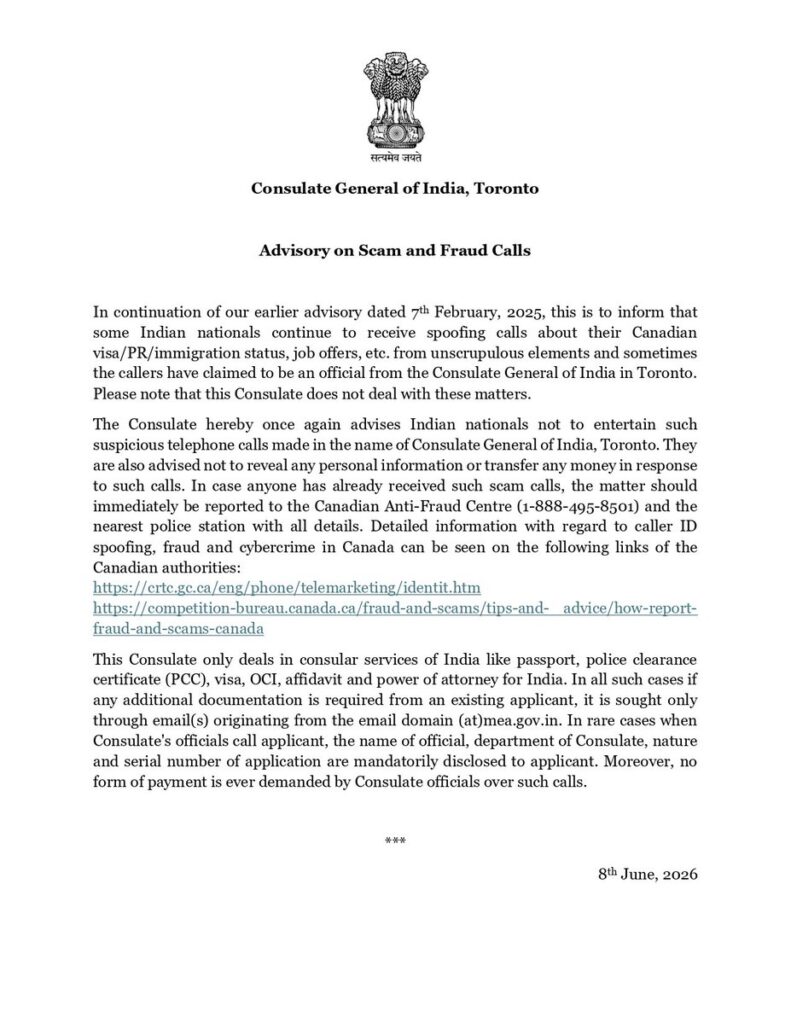
In an advisory posted on its website and social media platforms, including X, the consulate said Indian nationals are receiving spoofing calls from fraudsters regarding their Canadian visa, PR, immigration status, and job offers.
On some occasions, callers introduced themselves as officials of the Indian Consulate in Toronto. The consulate made it clear that it does not deal with these matters.
“The Consulate advises Indian nationals not to entertain such suspicious telephone calls made in the name of the Consulate General of India, Toronto,” the advisory said.
Indian nationals were also warned against providing any personal information or transferring money to the scammers.
Report the scam
On receiving such calls, Indian nationals have been advised to immediately report the matter to the Canadian Anti-Fraud Centre at 1-888-495-8501 and the nearest police station.
The consulate shared two links, urging Indian citizens to find more information about caller ID spoofing, fraud and cybercrime in Canada:
https://crtc.gc.ca/eng/phone/telemarketing/identit.htm https://competition-bureau.canada.ca/en/fraud-and-scams/tips-and-advice/how-report-fraud-and-scams-canada
How to identify a real consulate call
The Consulate General of India, Toronto, offers consular services such as passport, police clearance certificate (PCC), visa, OCI, affidavit and power of attorney for India. When additional information related to these services is required, the consulate said applicants receive emails from the domain @mea.gov.in.
“In rare cases when consulate officials call an applicant, the name of the official, department of the consulate, nature and serial number of the application are mandatorily disclosed to the applicant,” the advisory added.
The consulate made it clear that no form of payment is ever demanded by its officials over such calls.
IRCC continues to warn against immigration fraud and scams
Immigration, Refugees and Citizenship Canada (IRCC) also warns applicants against scams, frauds and abuse. IRCC says it never asks for money or promises a visa. It says only Canadian immigration officers at Canadian embassies, high commissions and consulates can decide to issue a visa.
IRCC has advised applicants to beware of several types of fraud, including representative fraud, artificial intelligence (AI) scams, social media scams, fake websites and other internet scams, email scams and telephone scams.
How to report
IRCC encourages applicants to report scams and fraud to the relevant authorities. Online, phone or text message scams must be reported to the Canadian Anti-Fraud Centre (CAFC). If any personal or financial information has been provided to the scammer, victims have been advised to contact local police or the RCMP.
In cases of immigration fraud, victims are encouraged to report the issue to the Border Watch Line of the Canada Border Services Agency. To report citizenship-related fraud, IRCC’s Citizenship Fraud Tips mailbox can be reached by email or through the Client Support Centre by phone.
Protection against abuse
IRCC has also outlined steps to prevent abuse, urging anyone experiencing abuse to report it to local police in an emergency and to contact the Client Support Centre. Officials encourage the public to know their rights and to learn how to identify abuse, neglect and forced marriage. Steps have also been listed for assisting foreign workers who are victims of abuse.
Human trafficking can be reported to the Canadian Human Trafficking Hotline at 1-833-900-1010, local police or 911. IRCC has strictly advised the public against taking the law into their own hands or engaging in any illegal activity.
For international students
IRCC says international students who are victims of document fraud may be granted permission to stay in Canada and could be eligible for a temporary resident permit if they meet three conditions: they came to Canada with a genuine intention to study, they unknowingly used fake documents, and they have been issued a removal order.
Such students have been advised to contact the Client Support Centre and report the fraud to the Canadian Anti-Fraud Centre.
Official information

With Canada remaining a top destination for people around the world, having accurate information about immigration services is more important than ever. Authentic information about Canadian immigration programs and policies is available on the IRCC website: https://www.canada.ca/en/immigration-refugees-citizenship.html